Soft-Tissue Response Around Ceramic Implants: What the Research Shows

Medically reviewed by Dr. Nicole Zimmermann, DDS — IAOMT-accredited biological dentist, Bloom Holistic Dental, Englishtown, NJ.
The long-term success of any dental implant depends on two distinct biological seals working in harmony: the bone-to-implant osseointegration below the gumline, and the soft-tissue seal that wraps securely around the transmucosal abutment above it. While bone integration receives significant attention, the peri-implant soft-tissue response is just as critical — serving as the frontline physical and immunological barrier protecting underlying bone and systemic circulation from the oral microbiome. At Bloom Holistic Dental, we utilize metal-free zirconia implants largely due to their superior biocompatibility and the favorable response of surrounding gingival tissues. Here is an evidence-based breakdown of what current clinical research demonstrates regarding ceramic implants soft-tissue integration.
Online discussions around dental implant materials frequently polarize into absolute claims: asserting either that metal implants are universally problematic or that material composition plays no meaningful biological role. In clinical reality, material selection does influence measurable tissue responses, bacterial adhesion rates, and local inflammatory signaling. Understanding this scientific context allows patients to make genuinely informed decisions within a holistic dentistry framework.
What Zirconia Is Made Of and Why It Behaves Differently
Dental zirconia is a crystalline, non-metallic ceramic — specifically yttria-stabilized tetragonal zirconia polycrystal (Y-TZP) — engineered for high fracture toughness, chemical inertness, and structural longevity. Unlike titanium, which relies on a dynamic surface titanium dioxide ($TiO_2$) passivating layer to maintain stability, zirconia is inherently bio-inert from its baseline state. It does not release metal ions into the peri-implant microenvironment, eliminating the risk of localized corrosion or metal-induced immunological hypersensitivity in predisposed individuals.
Transmucosal surface topography represents another key determinant of soft-tissue health. Excessive surface roughness at the gingival margin can encourage bacterial biofilm colonization, whereas a micro-machined or polished ceramic surface provides a clean substrate that facilitates human gingival fibroblast adhesion and hemidesmosomal attachment — establishing a robust, infection-resistant biological seal.
Why the Soft-Tissue Seal Matters as Much as the Bone
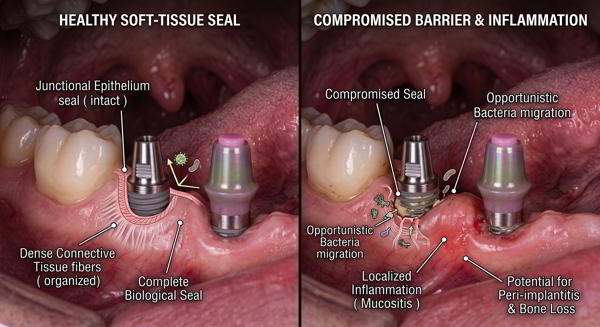
The peri-implant soft-tissue complex forms a protective biological cuff composed of junctional epithelium and dense connective tissue fibers that isolate the alveolar bone from intraoral pathogens. When this soft-tissue barrier is compromised, opportunistic bacteria migrate subgingivally, initiating peri-implant mucositis (localized soft-tissue inflammation). Left unchecked, this inflammatory state can advance to peri-implantitis, characterized by irreversible marginal bone loss and eventual implant failure. Maintaining a stable, tight soft-tissue seal is essential for long-term implant longevity.
Biological Advantages of Ceramic Implants for Gingival Health
The relationship between ceramic implants and the surrounding gingival collar represents a fundamental breakthrough in modern biological restorative care. When evaluating zirconia implants gum health, the non-porous structure of zirconium dioxide plays an essential role in preserving natural microvascular circulation. Unlike traditional metal options that can conduct galvanic currents and attract subgingival debris, ceramic materials remain completely bio-inert, minimizing the foreign-body reaction within the transmucosal zone.
Maintaining healthy peri-implant soft tissue zirconia interfaces depends on how well human gingival fibroblasts adapt to the restorative surface. Zirconia demonstrates a high degree of biocompatibility, encouraging mucosal cells to form dense hemidesmosomal attachments directly against the implant collar. This tight cellular adhesion establishes an effective barrier that resists pathogenic bacterial migration into subgingival spaces. For patients seeking biocompatible dental implants NJ, this robust cellular integration creates an aesthetic, natural-looking gingival cuff that matches the color and contour of surrounding natural teeth without gray shadows or chronic marginal irritation.
How Zirconia Interacts With Gum Tissue
1. Plaque Accumulation and Biofilm Kinetics
Zirconia exhibits low surface free energy and minimal wettability, which significantly diminishes early bacterial adhesion. In comparative microbiological evaluations, ceramic surfaces consistently demonstrate lower plaque accumulation and reduced biofilm colonization compared to traditional titanium surfaces, supporting healthier peri-implant gingival margins.
2. Inflammatory Signaling in Peri-Implant Crevicular Fluid
The biological response to an implant material can be monitored via inflammatory biomarkers in peri-implant crevicular fluid (PICF). Studies evaluating soft-tissue responses around ceramic versus titanium abutments show that zirconia surfaces maintain stable baseline cytokine profiles (including IL-1β, TNF-α, and leptin), reflecting minimal chronic foreign-body tissue irritation.
What the Evidence Concludes
A comprehensive systematic review and meta-analysis published in the National Library of Medicine (PubMed) evaluated clinical and histological soft-tissue responses around zirconia versus titanium implant components. The findings confirmed that zirconia abutments and implants demonstrate comparable or superior soft-tissue parameters, characterized by healthy probing pocket depths, favorable bleeding on probing indices, and reduced plaque accumulation, while offering distinct aesthetic advantages without adverse biological reactions.
Why We Choose Zirconia for Metal-Sensitive Patients
In addition to favorable soft-tissue compatibility, zirconia is 100% metal-free, preventing the grey metallic hue or dark shadowing that can occasionally show through thin gingival biotypes around titanium collars. Before proceeding with implant placement, our practice offers comprehensive biocompatibility testing to assess individual biological compatibility and ensure the chosen restorative materials align with your systemic health.
Supporting Healthy Soft-Tissue Healing After Placement
Optimal soft-tissue integration begins well before implant surgery. Resolving active periodontal infections and managing subgingival dysbiosis — using targeted biological modalities such as ozone dentistry — establishes a clean, vascularized tissue bed for healing. Following surgery, long-term stability is maintained through:
- Meticulous daily interdental hygiene and plaque control
- Avoidance of tobacco and vaping products that impair microvascular flow
- Adherence to regular 3- to 4-month periodontal and peri-implant recall evaluations
- Early monitoring for subtle mucosal color changes or bleeding on gentle probing
The Role of Surgical Technique in Soft-Tissue Outcomes
Material biocompatibility works in tandem with precise surgical execution. Proper three-dimensional implant positioning, preservation of thick keratinized mucosal tissue, and careful handling of peri-implant tissues are required to establish an optimal biological seal. Our practice evaluates bone volume, tissue biotype, and airway considerations comprehensively during initial diagnostics.
Optimizing Ceramic Implant Healing and Long-Term Tissue Stability
Achieving predictable ceramic implant healing requires a comprehensive approach that bridges meticulous surgical technique with supportive biological therapies. During the initial restorative phase, the gingival tissue reorganizes into a tight epithelial seal around the abutment. Because non-metallic surfaces exhibit lower bacterial plaque retention, the risk of early mucosal inflammation remains significantly lower compared to traditional alternatives. This low affinity for biofilm colonization creates a clean environment that supports uninterrupted tissue maturation and vascularization.
Long-term metal-free implant gum health also relies heavily on consistent supportive care following surgical placement. Integrating biological adjuncts like ozone irrigation during recall visits helps protect the peri-implant seal from opportunistic pathogens without disturbing beneficial oral microbiota. By prioritizing biocompatible ceramics alongside proactive periodontal maintenance, patients achieve a stable, natural soft-tissue barrier that protects the underlying alveolar bone and supports lasting oral-systemic wellness.
Frequently Asked Questions
Do zirconia implants cause less gum inflammation than titanium?
Clinical studies show that zirconia surfaces attract less bacterial plaque and maintain low inflammatory biomarker levels in crevicular fluid. While both materials can integrate successfully, zirconia’s smooth, non-metallic surface supports excellent gingival health and low biofilm retention.
How long does soft tissue take to heal around a ceramic implants?
Initial epithelial closure and mucosal adaptation occur within the first 2 to 4 weeks, with full connective tissue maturation and biological barrier formation establishing over 3 to 6 months.
Can I get biocompatibility testing before implant placement?
Yes. Biocompatibility testing helps identify individual immunological sensitivities to various dental materials, ensuring that only biologically harmonious ceramics and restorative components are selected.
What are the early signs that soft tissue around an implant is inflamed?
Early warning signs of peri-implant mucositis include localized redness, swelling, tenderness, or bleeding when brushing or flossing around the implant crown. Prompt biological evaluation allows early intervention before bone loss occurs.
Next Step
If you are exploring metal-free tooth replacement options, ensure your implant supports both functional strength and healthy soft-tissue integration. Schedule a zirconia implant consultation with Dr. Zimmermann at Bloom Holistic Dental in Englishtown, NJ, to evaluate your restorative options.
Address: 55 Willow Lane, Suite 203, Englishtown, NJ 07726
Phone: 732-792-3260
Email: bloomholisticdental@gmail.com
Hours: Mon 8–3, Tue Closed, Wed 9–4, Thu Closed, Fri 9–4; emergency by request.