What “optimal oral health” means in a biological framework
Most of us were taught that a healthy mouth means no cavities and no gum problems at your last check-up. That is a good start, but it describes the absence of disease, not the presence of health. Biological oral health asks a bigger question: is your mouth working well, staying in balance and supporting the rest of your body?
At Bloom Holistic Dental, this question sits at the center of holistic dentistry. A biological framework does not replace mainstream dental standards. It builds on them by looking at inflammation, the oral microbiome, function and the materials in your mouth, alongside your overall health.
In this post, we will explain how oral health is usually defined, what “optimal” means in a biological framework, the markers that matter, what the evidence supports, and practical steps you can take today.
How Oral Health Is Usually Defined
The mainstream definition is already broader than “no cavities.” The FDI World Dental Federation defines oral health as multi-faceted, including the ability to speak, smile, smell, taste, touch, chew, swallow and convey a range of emotions through facial expressions with confidence and without pain, discomfort and disease of the craniofacial complex.
The need is large. The World Health Organization reports that oral diseases affect nearly 3.7 billion people and that untreated tooth decay in permanent teeth is the most common health condition. WHO also notes that oral diseases share modifiable risk factors, such as tobacco use, alcohol and a diet high in free sugars, with other chronic diseases including cardiovascular disease, cancer, chronic respiratory disease and diabetes.
In everyday practice, though, “healthy” is often judged by a short list: no new cavities, no deep pockets, no pain. That list matters, but it can miss things. A person can be cavity-free and still have ongoing gum inflammation, a dry mouth, a restricted airway or a bite that strains the jaw. A biological framework tries to look at those quieter parts of the picture too.

What “Optimal” Means in a Biological Framework
Here is the working definition we use at Bloom. It is our own framing, not an official standard: optimal oral health is a mouth that is free of active disease, low in chronic inflammation, balanced in its microbiome, functioning comfortably, and supported by materials and habits that suit the whole person.
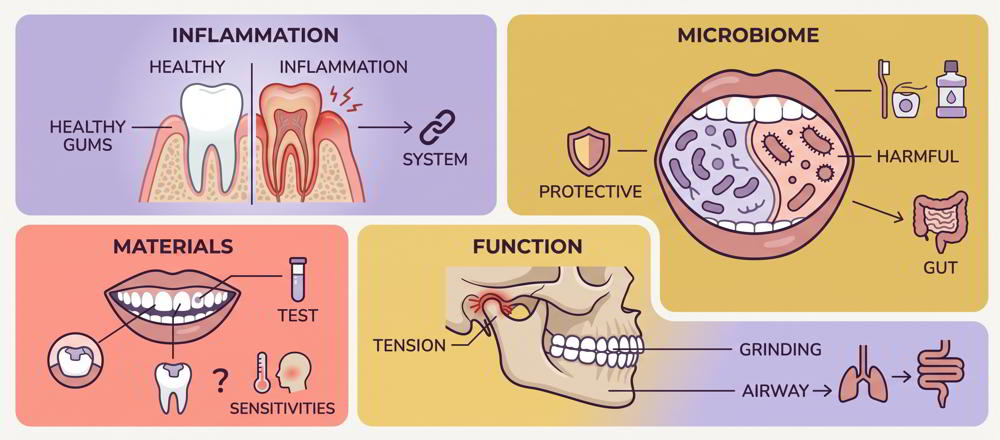
That translates into six markers. The table shows what a conventional check usually covers and the extra question a biological framework adds.
| Marker | Conventional check | Added question in a biological framework |
|---|---|---|
| Inflammation | Bleeding and pocket depths | Is there chronic, low-grade inflammation anywhere, including old extraction sites and root-treated teeth? |
| Microbiome | Rarely assessed | Do diet, dry mouth, rinses and habits support or disrupt the bacterial balance? |
| Function | Chewing and pain | How are the bite, jaw joints, tongue position and airway working together? |
| Materials | Intact and not leaking | Are the materials in your mouth a good fit for your health and sensitivities? |
| Nutrition and lifestyle | Advice to limit sugar | How do your overall diet, sleep, stress and tobacco use affect your tissues? |
| Whole body | History taken for treatment safety | Do your oral findings and your other health conditions influence each other? |
No single marker defines health. The point is to see them together, so that problems are caught earlier and treatment fits the person.
The Markers in Practice
Inflammation
Inflammation is the body’s normal response to injury or infection, but when it lingers it can strain the whole system. Healthy gums that do not bleed are a sign that inflammation is under control. We explore how mouth and body influence each other in our post on inflammation, dental issues and chronic health conditions.
Microbiome
Your mouth hosts a community of bacteria that can help protect or harm your tissues, depending on balance. Habits such as how you clean, what you drink and what you rinse with may influence that balance. For more, see oral microbiome and gut health, alcohol-containing mouthwash and the microbiome and why tongue scraping is beneficial.
Function
A mouth that looks healthy but strains to breathe, chew or rest comfortably is not truly in balance. Jaw tension, grinding and disrupted sleep may sometimes be linked to the airway, a connection we discuss in our post on why nightguards are often just a patch.
Materials
Fillings, crowns and implants stay in the mouth for years, so it makes sense to ask whether they suit you. Options include biocompatibility testing and biocompatible fillings, especially for patients with sensitivities or chronic health concerns.
Nutrition and lifestyle
What you eat, how you sleep and whether you smoke all show up in the mouth. Our post on diet and nutrition in dental and overall health covers this in more depth.
What Is Well Established, and What Is Still Developing
A good framework is honest about its evidence. Here is how we separate the two:
| Well established | Still developing |
|---|---|
| Plaque, sugar and tobacco drive tooth decay and gum disease | Which microbiome patterns best predict future disease in an individual |
| Oral diseases share risk factors with other chronic conditions | Whether treating oral inflammation changes outcomes for other conditions |
| Gum disease and diabetes affect each other | How much individual material sensitivity matters, and how best to test for it |
| Regular cleanings, exams and good home care protect health | The role of the airway and bite in many oral and sleep-related problems |
The links between oral health and other conditions are mostly associations. They are good reasons to take gum health seriously, but they are not proof that fixing one mouth problem will cure a different illness. We would rather tell you that than overpromise.
This is also why a biological framework works best alongside, not instead of, your regular dentist and physician.
Practical Steps You Can Take Now
You do not need special equipment to start moving toward better oral health:
- Keep up the basics. Brush twice a day, clean between your teeth daily and keep your regular cleanings and exams.
- Watch your gums. Bleeding, swelling or recession are worth mentioning early.
- Limit free sugars and tobacco. These are two of the most important modifiable risk factors identified by WHO.
- Review your rinse. If you use mouthwash, consider whether an alcohol-free option suits you better.
- Notice how you breathe and sleep. Snoring, dry mouth on waking and jaw tension are all worth raising.
- Know what is in your mouth. Ask what your fillings and crowns are made of, especially if you have sensitivities.
If you want a fuller picture, a holistic dental exam looks at these markers together. Bring your questions and your health history, and we will build a plan that fits you.
Frequently Asked Questions
What is biological oral health?
It is an approach that defines a healthy mouth by more than the absence of cavities. It looks at inflammation, the microbiome, function, materials, nutrition and how your mouth relates to the rest of your body.
Is a biological approach different from standard dentistry?
It builds on standard dentistry rather than replacing it. Cleanings, exams, X-rays and proven treatments remain the foundation. A biological framework adds extra questions and options, and is honest about where the evidence is still developing.
Can I have no cavities and still not have optimal oral health?
Yes. A cavity-free mouth can still have chronic gum inflammation, dry mouth, bite problems or materials that do not suit you. Those issues are easy to miss in a routine check.
Where should I start?
Begin with a thorough exam and an open conversation about your health history and goals. From there, small steps such as better home care, less sugar, avoiding tobacco and reviewing your materials add up over time.
The Bottom Line on Biological Oral Health
Biological oral health means measuring a healthy mouth by more than cavities. It adds attention to inflammation, the microbiome, function, materials and nutrition, always on top of the proven basics of cleanings, exams and good home care. The evidence for some of these markers is strong and for others still developing, and a good framework says so plainly. If you would like to see where your own mouth stands, the best next step is a thorough exam and an honest conversation.
Ready for a whole-body approach to your dental care? Bloom Holistic Dental proudly serves patients throughout New Jersey with IAOMT-accredited, whole-body dental care. Visit our New Patients page or contact our Englishtown office to schedule a consultation with Dr. Nicole Zimmermann.
Practice Name: Bloom Holistic Dental
Our Location: 55 Willow Lane, Suite 203, Englishtown, NJ 07726
Phone Number: 732-792-3260
Connect with Us: Visit our New Patients Portal to request an appointment or schedule a consultation with our friendly clinical team.
Medically reviewed by Dr. Nicole Zimmermann
Medical Disclaimer: This article is for educational purposes only and does not constitute medical or dental advice. Individual health decisions should be made in consultation with Dr. Zimmermann and your physician or another qualified healthcare provider.
Sources referenced:
FDI World Dental Federation: Definition of Oral Health
World Health Organization: Oral Health Fact Sheet (updated March 2025)