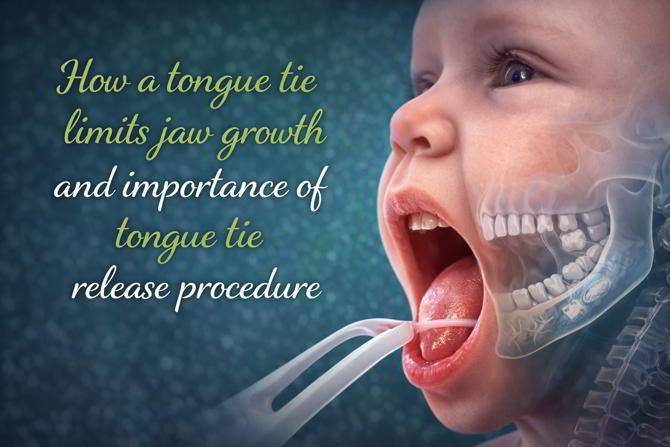
How a tongue tie limits jaw growth and importance of tongue tie release procedure
Most people have never given much thought to the small band of tissue connecting the underside of their tongue to the floor of their mouth. Yet this tiny structure — called the lingual frenulum — can have a profound and far-reaching impact on jaw development, airway health, sleep quality, speech, digestion, and overall wellbeing when it is too short, too thick, or too tight.
This condition is known as ankyloglossia, more commonly called a tongue tie. And while it is often dismissed as a minor issue or something children simply grow out of, the science tells a very different story. An unresolved tongue tie can silently limit tongue tie and jaw growth in ways that reshape the entire face and airway — with consequences that persist well into adulthood.
At Bloom Holistic Dental, we take tongue tie seriously because we understand the full biological picture. The tongue is not just for tasting and talking — it is a powerful muscular force that, when functioning correctly, shapes the palate, guides jaw development, and supports healthy breathing. When a tongue tie prevents the tongue from doing its job, the entire craniofacial structure can suffer.
In this post, we will explore exactly how a tongue tie limits jaw growth, what symptoms to watch for in children and adults, and why the Tongue Tie Release Procedure in New Jersey at Bloom Holistic Dental may be one of the most important interventions for your long-term health.
What Is a Tongue Tie?
A tongue tie occurs when the lingual frenulum — the thin membrane under the tongue — is abnormally short, thick, or tightly anchored to the floor of the mouth. This restricts the tongue’s full range of motion, preventing it from rising to the roof of the mouth, moving freely side to side, or protruding beyond the lips without restriction.
Tongue ties exist on a spectrum of severity. Some are immediately visible and obvious. Others — called posterior tongue ties — are hidden beneath the mucous membrane and require an experienced clinician to identify. At Bloom Holistic Dental, Dr. Nicole Zimmermann is trained to identify both anterior and posterior tongue ties that are frequently missed in conventional dental and medical settings.
How the Tongue Shapes the Jaw and Palate
The Tongue as an Orthodontic Force
To understand the relationship between tongue tie and jaw growth, you first need to understand the extraordinary role the tongue plays in craniofacial development. The tongue is one of the strongest muscles in the body relative to its size, and it exerts constant pressure against the palate — the roof of the mouth — during swallowing, speaking, and simply resting.
This constant, gentle upward pressure is not incidental. It is the primary force that widens and shapes the upper jaw, called the maxilla, during childhood development. A properly positioned tongue resting against the palate stimulates the midpalatal suture to expand, creating a broad, wide arch that accommodates all the teeth properly and supports a wide, open nasal airway.
When the tongue is tethered by a tongue tie and cannot rise fully to the palate, this critical developmental pressure is lost. The results are structural and they are significant.
The Cascade of Developmental Consequences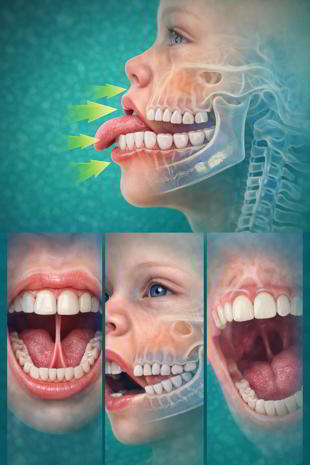
Without adequate tongue pressure against the palate, a cascade of craniofacial changes begins:
Narrow Upper Jaw — Without the tongue’s expansive force, the upper palate develops into a high, narrow arch rather than the broad, flat shape nature intended. This narrow palate crowds the teeth, often leading to the need for orthodontic intervention.
Underdeveloped Midface — The maxilla, which forms the cheekbones, eye socket floors, and the base of the nose, fails to develop forward and outward as it should. This results in a flatter, more recessed midface appearance.
Lower Jaw Compensation — As the upper jaw narrows and retrudes, the lower jaw — the mandible — compensates by also growing in a more downward and backward direction rather than forward. This directly affects the relationship between tongue tie and jaw growth in both jaws simultaneously.
Crowded Teeth — A narrow palate simply does not have enough room for all the teeth to erupt in proper alignment. Crowding, crossbites, and deep bites are extremely common consequences of untreated tongue tie.
High Vaulted Palate — The classic signature of a tongue tie’s effect on development is a high, vaulted palatal arch — a hallmark sign that experienced holistic dentists and airway-focused practitioners recognize immediately.
Tongue Tie and Airway Health
Perhaps the most serious consequence of the tongue tie and jaw growth connection is its impact on the airway. A narrow upper jaw means a narrow nasal floor — which means a restricted nasal airway. Children and adults with untreated tongue ties are far more likely to become chronic mouth breathers, because nasal breathing is simply more difficult with a structurally narrowed nasal passage.
Chronic mouth breathing sets off its own cascade of health consequences, including altered facial development, poor sleep quality, sleep-disordered breathing, and in children, behavioral and cognitive issues associated with sleep deprivation.
Furthermore, a tongue that cannot rest properly against the palate tends to fall back toward the throat during sleep — directly obstructing the airway and contributing to snoring and obstructive sleep apnea. The relationship between untreated tongue tie, jaw underdevelopment, and sleep-disordered breathing is one of the most critical yet underrecognized connections in modern healthcare.
Tongue Tie Symptoms: Are You or Your Child Affected?
Symptoms in Infants and Children
- Difficulty latching during breastfeeding
- Poor weight gain in infancy
- Clicking sounds during feeding
- Excessive gas and reflux
- Delayed or unclear speech development
- Mouth breathing and snoring
- Crowded or misaligned teeth
- Enlarged tonsils and adenoids
- Restless sleep and bedwetting
Tongue Tie Symptoms in Adults
Many adults carry an undiagnosed tongue tie that was never addressed in childhood. Symptoms in adults include:
- Chronic jaw pain and TMJ dysfunction
- Neck and shoulder tension and pain
- Chronic headaches
- Sleep apnea or snoring
- Difficulty pronouncing certain sounds
- Chronic digestive issues — the tongue tie affects the swallowing mechanism
- Dental crowding and bite issues
- Forward head posture
- Mouth breathing and dry mouth upon waking
If several of these symptoms resonate with you, a comprehensive tongue tie evaluation at Bloom Holistic Dental may be a transformative step toward resolving issues you have struggled with for years.
The Tongue Tie Release Procedure in New Jersey
What Is a Frenectomy?
A tongue tie release procedure — clinically called a frenectomy or frenotomy — involves releasing the restrictive lingual frenulum to restore the tongue’s full range of motion. When performed at the right time and with the right approach, this procedure can have a genuinely life-changing impact on jaw development, airway health, sleep, speech, and overall wellbeing.
At Bloom Holistic Dental, we offer the Tongue Tie Release Procedure in New Jersey using a precise, minimally invasive laser technique that offers significant advantages over traditional surgical methods.
Why Laser Frenectomy Is the Holistic Choice
Our laser tongue tie release procedure uses advanced soft tissue laser technology to release the frenulum with exceptional precision. The key advantages include:
Minimally Invasive — in Minimally invasive treatment ,No scalpels, no sutures, minimal bleeding. The laser seals as it cuts, dramatically reducing trauma to surrounding tissue.
Reduced Infection Risk — The laser simultaneously sterilizes the treatment site, eliminating the risk of post-operative infection without the need for antibiotics in most cases.
Faster Healing — Patients experience significantly less post-operative discomfort and faster tissue healing compared to conventional surgical release.
Superior Precision — Laser technology allows Dr. Zimmermann to release the frenulum with exceptional accuracy, ensuring a complete and effective release without damaging adjacent structures.
Biocompatible Approach — Consistent with our commitment to non-toxic, whole-body holistic care, laser frenectomy avoids the need for many conventional post-operative medications.
The Importance of Myofunctional Therapy
At Bloom Holistic Dental, we emphasize that the Tongue Tie Release Procedure in New Jersey is only one piece of the treatment picture. For the release to achieve its full potential — particularly in terms of tongue tie and jaw growth outcomes — the tongue must be retrained to function correctly after the procedure.
This is where orofacial myofunctional therapy becomes essential. Myofunctional therapy involves a series of targeted tongue and facial muscle exercises that teach the tongue to rest properly against the palate, swallow correctly, and breathe through the nose. Without this critical retraining component, the tongue may continue its old movement patterns even after the physical restriction has been released.
We work closely with experienced myofunctional therapists to ensure every patient receiving our Tongue Tie Release Procedure in New Jersey has access to the full spectrum of care needed for lasting results.
Don’t Let a Small Piece of Tissue Define Your Health
The connection between tongue tie and jaw growth is profound, well-documented, and deeply consequential for lifelong health. From narrow jaws and crowded teeth to sleep apnea, TMJ dysfunction, and chronic pain — the ripple effects of an untreated tongue tie touch virtually every aspect of physical wellbeing.
The good news is that with the right diagnosis, the right timing, and the right holistic treatment approach, these consequences are largely preventable and often reversible. The Tongue Tie Release Procedure in New Jersey at Bloom Holistic Dental offers patients a precise, minimally invasive, and genuinely holistic path to better function, better health, and a better quality of life.
Schedule Your Tongue Tie Evaluation Bloom Dental in NJ Today
At Bloom Holistic Dental, Dr. Nicole Zimmermann and her team are here to provide comprehensive tongue tie evaluations and holistic release procedures for patients of all ages across New Jersey.
Address: 55 Willow Lane, Suite 203, Englishtown, NJ 07726
Phone: 732-792-3260
Email: bloomholisticdental@gmail.com
Hours: Mon 8–3, Tue Closed, Wed 9–4, Thu Closed, Fri 9–4; emergency by request.